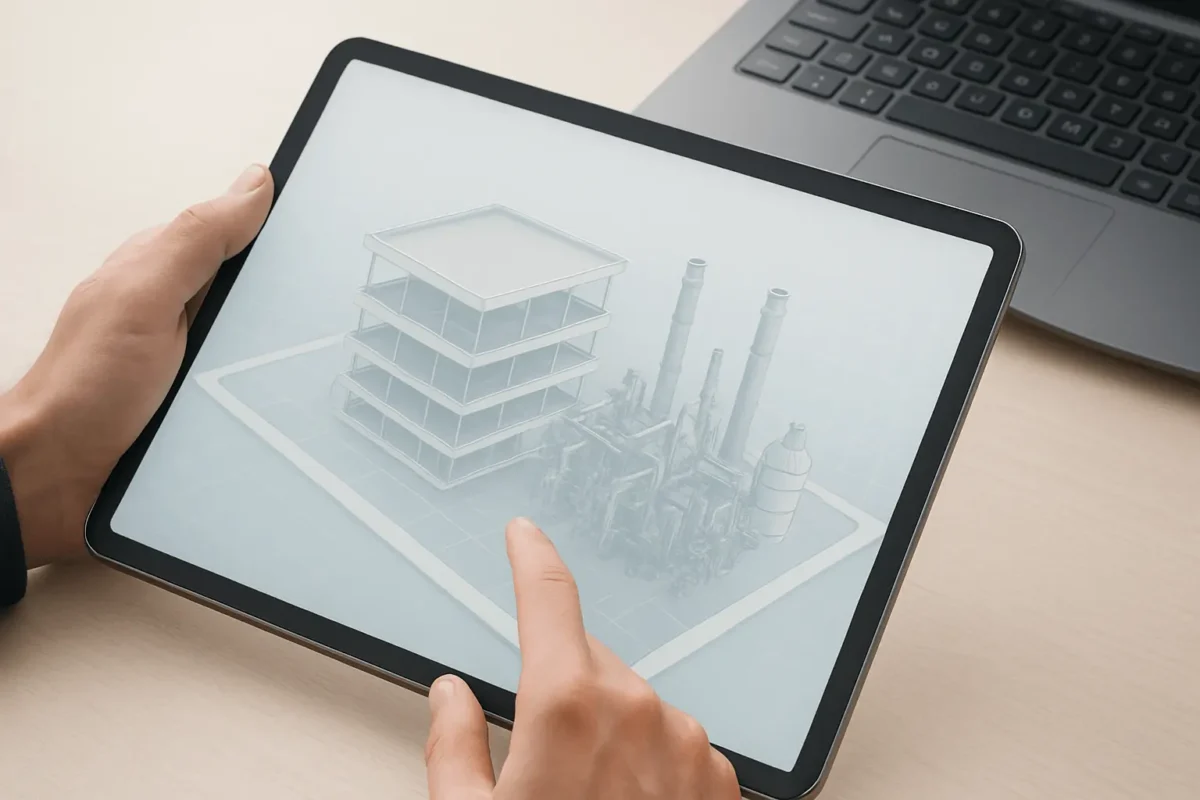
In a modern property management system, digital twins play a key role in enabling smart, efficient and sustainable property management. Here you can read how a visual interface, where the surfaces are displayed as a 3-D model or digital twin, simplifies administration and lays the foundation for a more future-proof management.
Today, digital twins are much more than just drawings. They are the very centre of digital property management, where all data is collected and made available from different perspectives with the visual interface as the common denominator. This contributes to a more integrated and dynamic approach that creates better conditions for long-term sustainable property management.
What is a digital twin in a property system?
A digital twin is a digital representation of a physical building in 3D. In the real estate system, it corresponds to a dynamic drawing that is integrated with other features of the system to create a more visual and accessible interface. An information hub, where location information, documentation and data can reflect reality from different perspectives.
Having access to up-to-date and accurate drawings is a key requirement in property management. Unlike traditional drawings, the digital twin can update changes in the property in real time and become a reference point making the information more useful and reliable.
Eight added values a digital twin can bring to property work
The transformation of drawings into digital 3D models in the building management system allows more people, with different needs, to have quick access to the information they need, whether for planning, operational work or monitoring. Here are some examples of how digital twins contribute to technical and financial management:
1. Effective management of drawings and documentation
By centralising and digitising drawing management, more people can quickly and easily access the same information and correctly updated images of the property directly in the system. This reduces unnecessary, manual administration and the risk of decisions being made on incorrect or inadequate grounds.
2. Clearer information during inspection and maintenance
A clearer, more visual link between location, object and action facilitates planning, follow-up and documentation. The fact that all measures can be linked directly to the right place in a building, for example when inspecting technical installations or specific spaces, makes work more flexible and ensures good, planned inspection and maintenance.
3. More accurate case management and faster action
When reporting faults and other issues, the digital twin provides technicians and managers with accurate location information directly linked to the issue. This makes it easier to localise the problem, estimate its extent and act more quickly. This contributes to more accurate interventions and a simpler everyday life for the entire management organisation.
4.Facilitates systematic fire prevention
Within Systematic Fire Prevention, digital twins are used, for example, to visualise escape routes, fire cells and protective equipment. With a direct link to checklists and action plans, it becomes easier to ensure structured fire protection work that meets current legal requirements and regulations.
5. Easier component management
The direct link between the component register and the digital twins creates a virtual copy in which all areas, building parts, systems and fixtures can be digitally localised. The visual interface allows you to drill down into the details of individual components and get information about connected sensors and IoT systems. Component management becomes more reliable, enabling higher performance and safety.
6. Increasing transparency in contract management
Premises, object information and drawings included in a contract become easier to monitor and follow up when the digital twins are also integrated with property data and contracts. In contract management, the digital twins contribute to better transparency and follow-up of leased space, utilisation rate and costs, and minimise the risk of incorrect billing.
7. Simplifies space planning and when there are changes
When rebuilding, extending or changing premises, it is easy to use the digital twin to visualise different options. Being able to plan and make simulations directly in the digital twin of the property system, and assess the impact of different interventions, saves time, money and management resources.
8. More data-driven decisions
Digital twins act as a unifying platform where technical, financial and operational data are interwoven with location information. With a visual interface, the big picture becomes clearer. This makes it easier to identify patterns, prioritise actions and make more informed decisions, at both strategic and operational levels.
Choosing a property management system is an investment for the future. A lot has happened in recent years with digitalisation, which has opened up completely new possibilities in property management. This is especially true for the use of digital twins.
In the Pythagoras property management system, the digital twins are an important hub for technical and financial management. Feel free to contact us to explore and experience the value of the visual interface and working with the support of digital twins. Want to know more about how we help other organisations? See our customer cases here.


