The digitalization of property management has long been about implementing systems. Today, it is rather about something more important: supporting the right processes.
For organizations within the public sector, industry and academia, properties are a central resource – both economically and operationally. A modern property management system therefore needs not only to store information, but to actively support the entire lifecycle: from strategic decisions to day-to-day operations.
Here are the most important processes a modern property management system should support.
Strategic planning and portfolio management
In many organizations, the largest costs concern long-term decisions: investments, disposals and prioritizations within the property portfolio.
A modern system should therefore support:
- Long-term planning of the property portfolio
- Investment plans linked to needs and condition
- Scenario analyses (e.g. what happens if we defer maintenance?)
For municipalities it may concern schools and care homes, for industry production facilities, and for universities campus development. Common to all is the need for fact-based decisions.
Property management and operations
Day-to-day operations are where efficiency really makes a difference.
A system should support:
- Inspection, rounds and operational follow-up
- Management of technical installations
- Energy monitoring and optimization
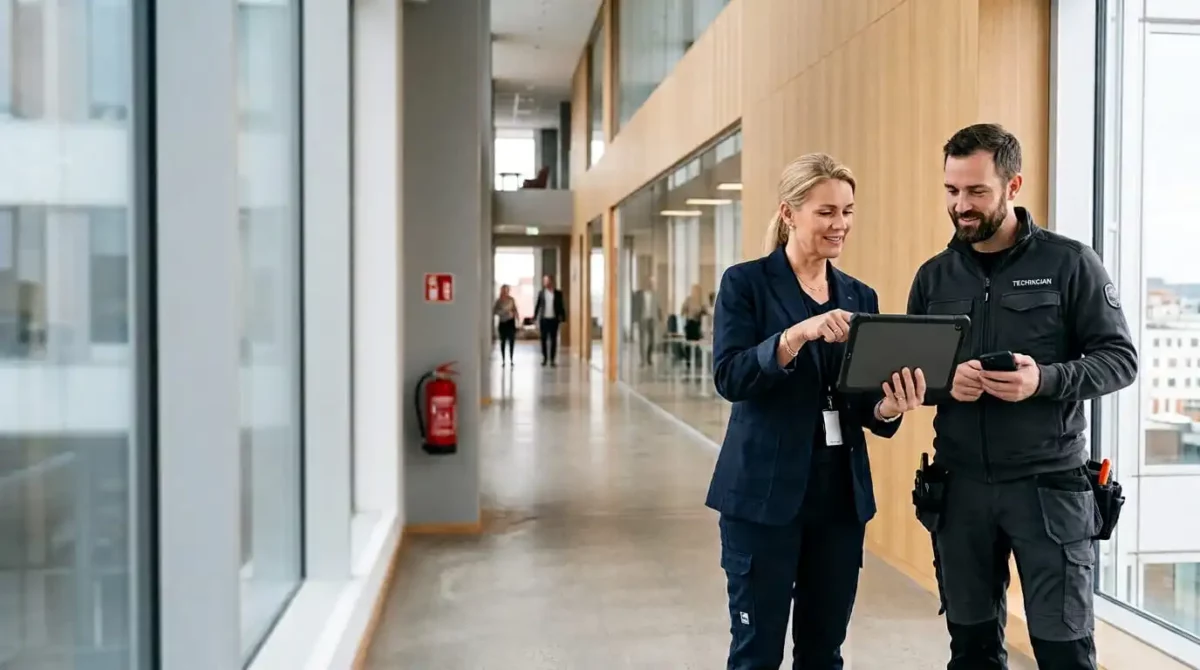
This is where mobility becomes crucial – technicians need to be able to work directly in the system on site, not after the fact.
Fault reporting and case management
A well-functioning case management process affects both customer satisfaction and efficiency.
A modern system should offer:
- Easy fault reporting (for tenants, students or staff)
- Clear prioritization and allocation of work
- Transparency and feedback
In public environments and on campus, this is often one of the most visible processes – and therefore also an important part of the overall experience.
Maintenance planning (planned and corrective)
Moving from reactive to proactive maintenance is a key factor.
The system should support:
- Long-term maintenance plans
- Condition assessments and action proposals
- The link between maintenance, budget and forecast
For industry, this can be critical for operational reliability, whilst in the public sector it is often linked to budget discipline and lifecycle optimization.
Project and investment management
Larger measures require structure and follow-up.
A modern system should handle:
- Renovations and investment projects
- Follow-up of time, cost and quality
- Integration with existing property data
It creates a continuous thread from planning to implementation – and onwards to future property management.
Contract management, lease administration and utilization
Properties are not just about buildings – but about how they are used.
System support should include:
- Contract management and contracts
- Invoicing and indexation
- Analysis of space utilization
For universities it may concern scheduling and occupancy rates, for municipalities internal rents, and for industry the efficient use of space.
Finance and follow-up
Financial control is central in all types of organizations.
A system should provide support for:
- Budget, forecast and outcome
- Cost allocation per property, building or operation
- Key performance indicators and reporting
The important thing here is to link the financials directly to the reality of the properties – not to manage them in a separate track.
Sustainability and environmental monitoring
Sustainability requirements are increasing rapidly – both from legislation and internal targets.
A modern system should be able to:
- Track energy consumption, climate impact and resource usage
- Support reporting (e.g. CSRD or internal targets)
- Collect data that enables improvement
For many organizations, this has moved from “nice to have” to business critical.
Data, integrations and digital ecosystem
A property management system does not operate in isolation.
It should:
- Integrate with financial, IoT and other operational systems
- Have a common and structured data model
- Enable automation
In particular within industry and larger organizations, this is crucial for avoiding silos.
Mobility and user support
The system must work in practice – not just in the office.
This means:
- Full support for mobile workflows
- Easy access to information in the field
- A user interface that is actually used
Adoption is often the greatest challenge – and at the same time the greatest opportunity.
Security, compliance and traceability
Requirements for documentation and control are increasing.
The system should ensure:
- Traceable history
- Support for legal requirements and internal guidelines
- Clear access control
This is particularly important within the public sector and regulated industries.
From system to process platform – what sets the best solutions apart?
The difference between a traditional and a modern property management system lies in the approach.
The best solutions:
- Are process-driven, not just module-based
- Connect the entire lifecycle
- Provide a common data foundation for all roles
It is no longer about having the “right features” – but about creating a cohesive way of working.
Conclusion: How to choose the right property management system based on processes
When evaluating a property management system, do not start with features – start with your processes.
Ask yourselves:
- Which workflows are most critical for us?
- Where are we losing efficiency today?
- What does our long-term development look like?
A modern property management system should not only reflect how you work today – but help you work better tomorrow. If you would like to know more about Pythagoras property management system, you can register your interest on this page and we will get in touch with you.