In times of change, it is common to feel insecure about what is new and unfamiliar. This is especially true when it comes to new ways of working through digitalisation and new technology. Here, Nacka Municipality shares its lessons learnt from the implementation of the Pythagoras property system.
When introducing new technologies, systems and procedures, it is natural that uncertainty increases and motivation decreases. Studies show that 70 per cent of all change initiatives do not achieve their objectives. It is also common that users do not fully utilise the IT systems that are implemented.
Change involves so much more than organisation, processes and systems. The big challenge is to create participation and influence individual, ingrained behaviours. It is therefore important to find ways to create the right understanding and incentives. Only then can the objectives be achieved and the full benefits of change be realised.
Organisational change with a focus on common ways of working
Nacka Municipality has been using Pythagora’s property system since 2015. Over the years, the collaboration and the system have been continuously developed. In 2024, when the municipality was facing a major implementation of five new technical modules in the property system, they realised the challenges of the change process and chose to enlist the help of Pythagora’s partner, the consulting company Implero.
– Even before we entered the new implementation project, we realised the difficulties. It’s a big organisation with many people involved, all going in the same direction at the same time. We also felt that it is easy for us in the project team to motivate ourselves, but there are many more of us. In addition, we in the project group may not be the ones who will then work in the system once it is implemented. That’s why it was important to get the employees on board and get the information out in the right way. What we want, how we want to do it and who is going to do it,” says Johanna Cook, System Manager and Object Manager at Nacka Municipality and Project Manager for the implementation.
One of the keys was to embed the project with managers from the outset to ensure that the right organisational resources could be allocated to the project, and to be clear that it will both take time and cost money. As is often the case in this type of project, it is the people who already have the most to do who are also the ones you want to include in the project. It is therefore important to anchor and plan for this at an early stage.
– Something we worked a lot on and prepared for before we started the project was to ensure that it would take time and that that time could be prioritised. This was an important part of the implementation and our change work. Early on, we set our sights on getting everyone to work in the same way with Pythagoras. It was an important goal for us, to be able to get away from Excel sheets and paper in the desk drawer,” explains Johanna.
Project manager’s best advice for change management
Nacka Municipality is still in the middle of the change process, but Johanna Cook highlights some factors that can already be seen as important for success:
Involve, create clarity and commitment early in the project

Start by finding out who is affected and how. Talk to the people in the organisation who have the right knowledge about the different functions. This will provide many valuable insights to take the next steps and plan the project based on the different stakeholder groups.
In addition to the responsibility for the Pythagoras modules that Nacka Municipality already works with in its operations, a number of ‘Project Specialists’ were appointed with responsibility for the five new modules in Pythagoras, at system, module or respective function level. In such a large project, it was important to distribute the responsibility among several, with clear role descriptions.
– It is simply not possible for one person to keep track of all the functions in all the modules when it gets so big. That’s why we need to gather knowledge from those working on the ground. They were given clear responsibilities and role descriptions to be aware of what is expected of them. For us, it was important to assign and clarify those responsibilities early in the project.
Lack of information is a common theme in many change projects and it is not possible to be too clear.
– What you communicate is one thing, but in some cases how is even more important. For example, it is not enough to talk more generally with and about ‘you as a group, we as a unit’. Then it’s easy to interpret that someone else will do it instead of it being your own personal responsibility,” says Johanna.
The communication plan is an important tool from the very beginning of the project. To create clarity and the right engagement, the messages also need to be customised to the different perspectives of the recipients, repeated and followed up.
– We can get even better at understanding how the communication lands with and is acknowledged by those it concerns, so that those involved also know in practice what is expected over time and take their responsibilities. This can make the handover between different phases of the project even smoother, for example between the preparation phase and implementation, or between different responsibilities within the project and towards the organisation.
Johanna also emphasises the importance of clarity in what decisions are made and how they are documented, as well as how they should be anchored and who can make decisions at what level.
Take control of the change
Do not wait for things to happen by themselves. It is important that someone takes responsibility for driving the change. One key is to articulate early in the project WHY we are making this change. This is crucial to ensure that those involved in the project really understand, get involved and are able to pass it on so that the rest of the organisation also understands.
– It was important for us to create a good understanding of where we are today and where we are going. Even before we signed the agreement with Pythagoras, we formulated our target image and then we contacted Implero to analyse the current situation.
Measure along the entire route
Measuring continuously along the way creates awareness of the organisation’s understanding of the change. Do employees know what is going to happen, why it is happening and what the change means? Measuring is also a good way to capture gaps and important things in the project that may have been missed along the way.
Managing expectations is extremely important, with measurement becoming an important yardstick for how well the project aligns with reality. Having recurring questions during all project phases is good for measuring the progress of the change work.
Nacka Municipality has conducted its first survey and is now about to conduct its second.
– Even when the questions are formulated for the first time, it is good to keep in mind that they can also be asked in later parts of the project. Some specific examples are: ‘How do you think the planned maintenance works today?’, ‘Do you get the information you need in your role?’ as well as more general questions such as how satisfied you are. Work with managers also remains important. For example, we follow up on how the team leaders perceive their groups and what they think should be improved,” says Johanna.
The main purpose of measuring in this way is to know where you are in the organisation, so that the right support measures can be put in place.
Visualising the change process
In larger projects, it is not easy for the organisation to take on board everything that needs to be done. By visualising the change process with different activities and models, it is easier to create understanding, manage expectations and set goals along the way.
One piece of advice is to distinguish between functions, such as Planned Maintenance, Supervision and Maintenance, Rental Administration, etc. Interviewing the organisation gives a good picture of how things look today, both in terms of process flow and function. It contributes to a better understanding and increased awareness in the organisation of where they are and what should be prioritised.
– To set the right expectations, we clarified the different phases of the implementation project, the Establishment Phase and the Stabilisation Phase, and visualised it in different steps. It has also been important for us to emphasise that development work will continue even when the new modules are fully operational. Then the real journey begins.
Focus on the ‘green path’
In a change process, it can be easy to get stuck in negative thoughts when faced with an uphill battle: ‘I don’t understand’; ‘Things were better before’; ‘I’ll only change if I’m forced to’.
Instead, focusing on and creating awareness of the positives of the change creates higher engagement, a more positive experience and more collective participation. This in turn provides better momentum in the change process.
– We particularly thought about this in Nacka municipality and how we would get it. It might be cliché to say “let’s be positive”, but we really tried to encourage everyone to be positive about the change. We also stated that we don’t want any bullshit in the corridors. It’s so easy to complain if you’re unhappy with a function or a field, which are details in the big picture. Petty grumbles so easily grow into a negativity that is contagious. Instead, we want the approach to be ‘come up with a solution and we’ll take it forward’ and support each other.
About Nacka Kommun
Nacka municipality is one of the larger municipalities in Stockholm County, with a population of just over 100,000. The municipality’s property portfolio includes schools and preschools, LSS and retirement homes, sports facilities, cultural buildings and administrative premises. The municipality also has a large number of rental properties. Property management is part of the municipality’s strategic work to create an attractive, sustainable and well-functioning city. As part of its efforts to become a ‘smart city’, Nacka municipality uses digital tools to streamline property operations, energy use and maintenance planning.
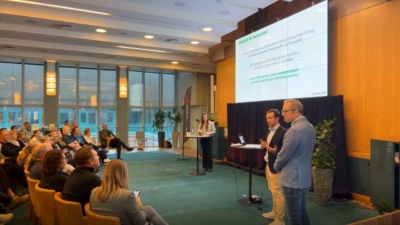
The customer case is inspired by Nacka Municipality and Implero’s presentation at Pythagoras Customer Day 2025.